CYBERBLOG
Vulnerability prioritization: decide what to patch with evidence, not noise
Prioritize vulnerabilities using exploitation evidence, asset exposure and business impact, with practical decision records and patch-verification checks.
By Harpreet Singh, CISSP, CCSP · Reviewed November 24, 2026
A vulnerability queue becomes useful when it tells an owner what to do next and why. Sorting thousands of findings by a severity number cannot answer that question on its own. The practical decision depends on applicable software, reachable attack paths, exploitation evidence, business consequences and whether a change can be verified.
This guide gives security analysts and service owners a repeatable way to build that decision record. It connects the week's exploited-vulnerability updates to a durable operating process, without pretending that one score or checklist can measure every organization's risk.
In this report
A score is a starting point, not a change order
The Common Vulnerability Scoring System (CVSS) describes technical severity. Its base assessment does not know which service your organization exposes, whether a recovery system uses the same component, or how an outage would affect customers. FIRST provides threat and environmental metrics to add context. Keep the score, vector and version together: a bare number stripped of its assumptions is poor evidence. [1]
A critical issue on an isolated test machine still needs an owner and remediation. An actively exploited weakness on a reachable identity service may require a faster decision even when its score is lower. These are different judgments: severity describes the flaw; priority decides what your team should do about a specific deployment now.
Start with the production patch-verification guide if your team already knows its priority but needs to prove a fix is running. This report addresses the earlier decision: allocating response effort across competing findings.
Build an asset-level decision record
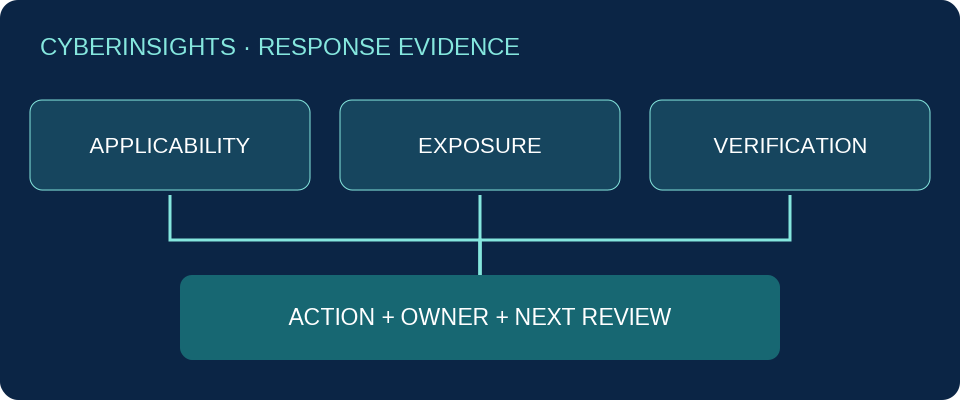
A spreadsheet of CVE identifiers cannot tell you whether a vulnerable service is actually deployed. Create one record per affected service or meaningful deployment group. Name its technical owner, business owner, environment, running version, exposure paths and evidence date. Separate the production service from its standby, disaster-recovery copy, administrator workstation and build image when their controls differ.
Reconcile scanner results with deployment manifests, package records and an owner-confirmed inventory. A scanner may identify a library that is present but not loaded; a package inventory may miss an embedded runtime. Resolve that disagreement rather than selecting whichever source makes the backlog smaller. Record unknown applicability explicitly with an assigned investigation owner and review time.
The record should let a second analyst reconstruct why the team acted. Include advisory revision, relevant configuration, evidence location, maintenance constraints, temporary controls, acceptance tests and exception expiry. Store sensitive evidence in the approved repository, not in a broadly shared worksheet. The downloadable register contains column headings only.
Use exploitation evidence without misreading it
CISA's Known Exploited Vulnerabilities (KEV) catalog identifies vulnerabilities with evidence of exploitation. Its November 23 snapshot includes MONAI Label CVE-2026-133968 and N-able MailAssure CVE-2026-134624, both added that day. A listing is a strong reason to check applicability promptly; it does not establish that your own system was compromised. The catalog records ransomware use as unknown for both entries. [2]
Retain the source snapshot and its publication time. Do not allow a stale dashboard label to overrule a newer primary advisory. Equally, absence from a catalog does not prove a vulnerability is safe: new exploitation may not yet have been assessed or published.
A public proof of concept, a vendor statement of exploitation and a verified incident in your environment are different evidence categories. Do not merge them into a generic red flag. Record what is known, by whom, at what time and with which limitations. An urgent but uncertain finding needs a time-bound investigation, not an invented confidence percentage.
Map reachability as a path, not a yes-or-no field
Ask which identities and networks can reach the vulnerable component and under what conditions. Check public ingress, partner VPNs, administrator networks, application-to-application calls and recovery environments. A service behind a reverse proxy may still have a directly reachable origin. A private address may be accessible through a compromised workload.
Use existing firewall rules, cloud configuration, service ownership and approved connectivity tests. Do not scan systems outside your authorization or send exploit payloads to production. Document the tested source, destination, protocol, time and expected result. A blocked connection from one workstation establishes only that one path was blocked.
Review the privilege and data boundary beyond the service. Does it hold credentials for storage? Can it write application files? Does it manage other systems? Could changing it interrupt a critical workflow? These questions guide containment and recovery planning even before an exact attack chain is known.
Make the response decision explicit
| Observed situation | Practical decision | Evidence needed next |
|---|---|---|
| Unexpected activity on an affected system | Escalate through incident response while controlling exposure | Preserved timeline, affected identities and recovery scope |
| Applicable exploited flaw with a reachable service | Expedite supported remediation and interim containment | Owner-confirmed inventory, changed access paths and acceptance result |
| Applicable flaw with a claimed compensating control | Verify the control and schedule remediation | Coverage, bypass paths, operating health and exception expiry |
| Applicability or exposure unknown | Assign urgent investigation according to plausible impact | Named owner, missing facts and a near-term decision time |
This is an editorial decision aid, not a replacement for your organization's incident thresholds or an official scoring model. An accountable service owner should agree the action and deadline with security and operations. Do not average unrelated ratings into a precise-looking risk score without a justified method.
When capacity is constrained, show the trade-off. Explain which exposed service receives the next maintenance slot, what remains vulnerable and which control will reduce risk until the other service is updated. A queue ordered by CVSS alone conceals those decisions rather than eliminating them.
Test temporary controls before relying on them
A web application firewall (WAF) can reduce exposure for inspected web requests. It does not automatically cover every protocol, origin path or internal client. An access rule may constrain who reaches a service without fixing the vulnerable code. An application authentication setting may reduce unauthenticated access while leaving trusted-user attack paths relevant.
For every temporary control, record the covered path, responsible operator, deployment state, monitoring and removal condition. Confirm normal traffic still works. Prefer an authorized synthetic acceptance test that exercises the intended restriction without attempting exploitation. Check exceptions, alternate hostnames and failover behavior.
Escalate when the assumed control is not observable or fails its acceptance check. Do not quietly convert an unverified mitigation into a permanent exception. Continue with the vendor-neutral WAF and firewall discussion for control-boundary questions; it should not be read as a universal virtual patch for other vulnerabilities.
Treat patching as an operational change
NIST SP 800-40 Rev. 4 describes enterprise patch management as a lifecycle that includes identification, prioritization, acquisition, installation and verification. It frames patching as preventive maintenance supporting the organization's mission. [3]
Translate that lifecycle into acceptance criteria before the change. Identify the supported update path, backup and restoration requirements, maintenance window, dependent applications and rollback conditions. Test representative business workflows with their owners. A health endpoint returning success may miss a broken export, authentication integration or scheduled job.
Verify the running process or image after restart or redeployment, not only the package downloaded to disk. Check every relevant node and the template that could recreate an old instance. A rollback that restores a vulnerable build reopens the security decision; it is not a successful closure because availability recovered.
Keep compromise investigation separate. Applying a fix stops neither an already established unauthorized session nor every consequence of earlier access. Preserve relevant evidence and involve the incident lead when the exposure history or observed activity warrants it. Our MONAI Label response analysis illustrates why patch state and investigation state should be recorded separately.
Two hypothetical decisions and their consequences
Hypothetical example: the quiet management server. An operations team postpones an applicable exploited flaw because the server has a private address. A partner connection can still reach its management service, and the server holds privileged automation credentials. The private-address label concealed a trust path. A useful correction is to verify partner reachability, constrain unnecessary access and expedite a supported fix while preserving logs. This is an illustrative scenario, not a reported incident.
Hypothetical example: the emergency update that breaks recovery. A team patches its active application but leaves the standby on the old image. A later outage activates the vulnerable standby. The change record's single green status misrepresented two deployments. Separate acceptance results for active, standby and deployment templates make the gap visible.
Neither scenario implies that every private service is exposed or every emergency update fails. They show why evidence must describe the actual system and its operational dependencies. A consequence discussion is useful when it changes the next check; dramatic estimates without supporting data add little.
Close the decision with evidence and a review date
- Confirm product, version and configuration applicability against the current primary advisory.
- Record relevant exploitation evidence with source and collection time.
- Verify the important reachability paths and service privileges.
- Name the action owner, business dependency, deadline and temporary controls.
- Agree patch, operational and security acceptance tests before the change.
- Record each running instance's result and any rollback or exception.
- State investigation scope, visibility gaps, residual uncertainty and next review.
Download the one-page decision checklist · Download the blank evidence register
A useful weekly review asks whether the oldest exceptions still have valid evidence, whether unexpected exposures were found and whether the same deployment repeatedly returns to the backlog. Track those observations before adding new dashboards. Describe the control improvement through your NIST CSF 2.0 improvement process without calling a completed worksheet proof of compliance.
Knowledge check: Does a blocked public connection justify closing an applicable flaw? No. It supports one exposure assessment; internal paths, supported remediation, operating checks and exceptions still need decisions. Does a completed update prove there was no earlier compromise? No. Patch verification and incident assessment answer different questions.
Reviewed November 24, 2026. This report provides an editorial workflow and hypothetical teaching examples. No customer environment, detection rule or operational change was tested. Reassess decisions when advisory evidence, exposure or service importance changes.