SECURITY ANALYSIS
Java4Shell beyond patching: WAF, firewall and compensating controls

Executive Summary
- Who is affected. Teams with potentially affected Java services that cannot immediately complete supported runtime remediation, including bundled products and non-HTTP integrations.
- What to do first. Map every entry route and identify supported temporary protections; verify the actual WAF attachment, inspection scope and effective enforcement action.
- How to verify. Use benign routing and functional checks, supplier evidence for vulnerability-specific efficacy, running-process validation and an owned exception with an expiry.
Build a vendor-neutral Java4Shell defense plan with WAF coverage, firewalls, runtime mitigation and safe validation, with key limits and patching evidence.
Read the original Java4Shell analysis →
What a compensating control can honestly promise
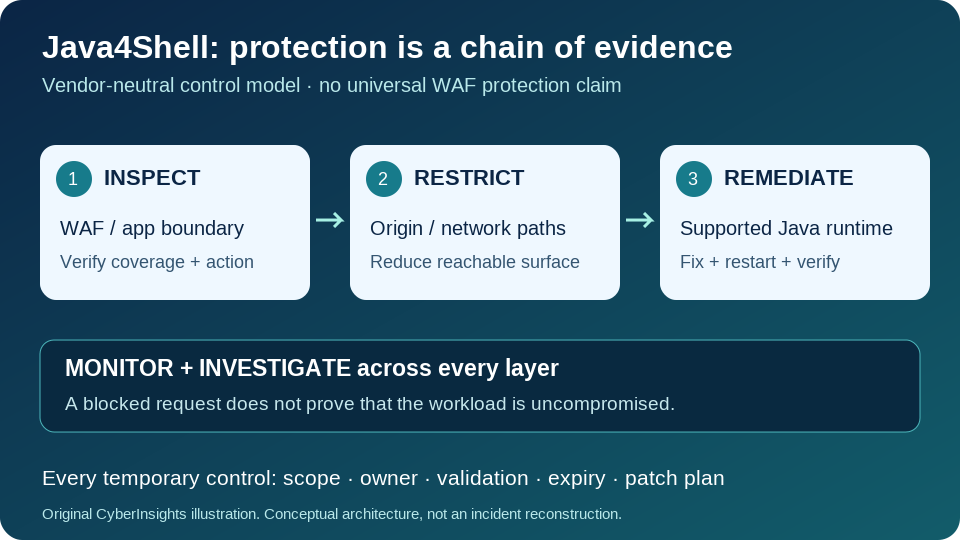
A WAF can reduce exposure to traffic it inspects. It cannot repair the Java runtime behind it. For Java4Shell, the practical question is whether a verified protection applies to the application’s actual input path, inspection point and enforcement mode. While a supported update is prepared, teams can combine boundary controls with runtime mitigation, network restrictions and monitoring. Each layer needs evidence, an owner and an expiry. This companion to our runtime-verification analysis explains how to make those decisions without treating a blocked test request as proof that the service is safe.
Start with the Java4Shell exposure and patch-verification analysis for the runtime inventory. Here, the focus is the temporary protection plan, its operational consequences and the evidence required to retire it.
Separate verified guidance from local design decisions
CISA’s November 17 bulletin prioritizes patching and identifies temporary boundary measures when immediate remediation is not feasible. The Canadian Cyber Centre also discusses restricting exposed applications and runtime mitigation. These are source-backed directions, not an assertion that every WAF configuration provides a complete substitute for patching. Read the official CISA bulletin [1]; review the Canadian alert [2].
CERT-EU describes exposure as conditional on the affected Java environment, relevant CPU capabilities, an active optimized decoder and untrusted input reaching it. The same advisory says documented temporary runtime options require restarting the JVM. That makes the running service and its request path the unit of assessment, rather than the presence of a security appliance somewhere in the network. Check the exposure and mitigation prerequisites [3].
Microsoft’s November 17 Azure WAF guidance describes mitigations for known HTTP-based exploitation patterns and distinguishes applicable request locations and Azure services. It explicitly complements runtime updates. This is a vendor statement about those protections, not an independent test by CyberInsights, a universal signature or a recommendation to translate a regular expression unchanged between products. Read Microsoft’s scoped WAF guidance [4].
Confidence is high in these published statements. Protection in your deployment remains unverified until you establish scope and test the relevant behavior. The workflow, control matrix and scenarios below are original editorial recommendations. We did not execute exploit traffic, validate a commercial rule against Java4Shell, or assess any reader’s production environment.
Draw the paths before choosing the rules
List the ways a request or message can reach each affected service: the public hostname, an API hostname, a partner integration, internal traffic, administration and recovery endpoints. Include alternate listeners and failover environments. Record where transport encryption ends, where inspection happens and whether the application receives another representation after intermediary processing.
For each path, identify the enforcing control, policy attachment, mode, owner and evidence source. A policy existing in a management console is different from a policy attached to the intended resource. A policy attached to the primary resource says nothing about a standby route unless that route is checked too.
The origin service must not accidentally offer an unrestricted path around the approved inspection point. Review network and application access restrictions through supported procedures, including authorized management and emergency access. Validate them with benign connectivity checks from approved locations. Do not publish or probe a third party’s origin addresses as part of this exercise.
For non-HTTP message processing, an HTTP WAF is not automatically on the relevant path. Treat that as a separate control problem. Network isolation, supported product restrictions and runtime remediation may be the meaningful options. A single green status for the whole application hides this distinction.
Choose layers by what they actually change
| Layer | What to establish | Important limit |
|---|---|---|
| Supported runtime fix | Correct vendor build deployed and running after restart | Does not prove the service was never compromised |
| Supported temporary JVM setting | Setting effective in every relevant process, with health tests | Build, architecture and launcher support must be checked |
| WAF / application filter | Applicable inputs inspected and a verified action enforced | Uninspected routes, unsupported protocols and rule limits remain |
| Network access restriction | Only approved traffic reaches the service or origin | Allowed clients can still reach an affected application |
| Segmentation / outbound policy | Only required downstream and outbound flows are permitted | Does not remove the initial memory-corruption condition |
| Least privilege / endpoint controls | Service identity and endpoint protections have appropriate scope | Detection and containment are not guaranteed prevention |
Use the matrix to challenge ownership gaps. A firewall team may prove a route restriction while an application owner proves that an update took effect. Neither should be asked to certify the other’s evidence. Record distinct protection claims so a partially complete change does not become an undifferentiated “mitigated” status.
Build a WAF protection plan around the application contract
A web application firewall, or WAF, evaluates web traffic against configured rules. A virtual patch is a protective policy outside the vulnerable code. OWASP treats virtual patching and code-level correction as complementary work, with a preparation, analysis, testing and follow-up lifecycle. That is a useful discipline for emergency changes. Review OWASP’s virtual-patching method [5].
Begin with documented input locations, legitimate formats and business limits. Identify the supported vendor rule or application-specific validation requirement that applies. Record the product, engine and rule-set revision, selected components, action, exceptions and affected resources. Ask the supplier what its protection has been validated to cover and what remains outside that coverage.
Do not begin by blocking all Base64-looking text. Normal authentication and integration workflows can carry encoded values. Rejecting an entire encoding category can create a service outage without establishing a precise protection claim. A security rule needs to distinguish the documented unsafe condition while preserving the application’s intended contract; where that distinction is not established, say so.
Positive validation can be useful when the owner knows what an endpoint accepts: permitted methods, appropriate content types, required fields and business-specific size bounds. These are application-policy decisions. The security team should not invent arbitrary limits and call them a Java4Shell fix. Agree them with the owner, test normal clients and document exceptions narrowly.
Examine rule order and effective action, not only rule names. An earlier allowance, a route exclusion or a rule override may change what actually happens. Export the effective policy before and after the change and associate it with the protected resource. Preserve the last known working configuration so rollback does not depend on memory.
Prove inspection coverage, including the awkward cases
Inspection can be narrower than the request an application receives. AWS, for example, documents size and count limits for particular request components and explicit oversize-handling choices. Its documentation explains that allowed requests can include content beyond what the WAF inspected. This illustrates a coverage question to ask of your own supplier; AWS limits are not universal settings for other WAFs. Read the documented inspection and oversize behavior [6].
For the selected product, review component selection, body parsing, content-type support, encrypted-traffic visibility and handling of oversized or unparseable inputs. Also review headers, cookies and query parameters where your application uses them. The task is to document what the application can receive without the intended examination, not to construct a bypass example.
Map legitimate uploads, authentication exchanges and partner messages to their inspection policy. If a necessary workflow exceeds a limit, record whether the product can inspect it, whether another validated control covers it or whether the service must be restricted temporarily. An exception should identify a specific business flow and owner. A broad exemption for an entire hostname can undermine unrelated protections.
Review representation changes with developers: which component decodes or parses a field, and what the next component receives. A pattern evaluated against one representation may not describe the application’s eventual processing. Do not claim equivalence based on a similar-looking rule editor in another vendor’s console. Rule semantics, transformations and parsing behavior need their own verification.
Roll out safely: observe, enforce and verify
Prepare an authorized staging environment, representative benign transactions, expected decisions and rollback criteria. Test business-critical paths, including login, token renewal, normal API calls, scheduled integrations, approved uploads and error handling. Use synthetic data and avoid live credentials in test captures. Mark every test as a functional check, policy-enforcement check or vulnerability-specific validation so the results are not conflated.
AWS recommends staging and tuning before testing changes in count mode on production traffic. Microsoft distinguishes detection mode, which logs without blocking, from prevention mode for supported WAF deployments. Those examples show why a dashboard match count cannot establish enforcement. Mode names and exact behavior must be confirmed for the deployed product. Review AWS’s testing guidance [7]; check documented WAF modes [8].
Observation mode helps identify operational impact; it is not temporary blocking protection. If urgency makes observation-only coverage unacceptable, restrict reachability or use a supported runtime mitigation while tuning proceeds. The incident or service owner must decide the allowed exposure. Do not silently leave a critical exception open because a rule is collecting useful logs.
For a benign enforcement check, use a dedicated approved test condition in staging and establish the expected decision at the edge and the expected absence of that request at the origin. Correlate a synthetic request identifier through available logs. This checks routing and enforcement plumbing; it does not prove that the same policy catches Java4Shell exploitation. Vulnerability-specific efficacy requires applicable supplier evidence or a separately authorized specialist validation.
After enabling the approved action, compare normal transaction success, latency, errors and support reports with the agreed baseline. Define when to stop the rollout, narrow a rule or invoke rollback. A rollback should trigger the documented alternative protection and renewed risk decision, rather than quietly restoring unrestricted exposure.
Use firewalls to reduce reachability and contain consequences
A network firewall governs permitted traffic flows; a WAF evaluates web-layer content within its supported inspection scope. Some products combine these capabilities, but a product label is not evidence that a particular feature is enabled for a particular flow. NIST’s firewall-policy guidance is a useful foundation for explicit policy, administration and testing, not a Java4Shell-specific protection claim. Read the NIST firewall-policy reference [12].
For inbound policy, identify required clients and services before narrowing access. Where the application permits it, restrict the exposed service to approved intermediaries or trusted integration paths. Consider internal users, partner networks, monitoring, deployment services and emergency administration. Verify that an apparently private listener cannot be reached through another permitted network path.
For segmentation, separate the application’s required dependencies from broad access to an entire server or database network. A service that needs one approved datastore should not inherit unrelated administrative reachability by accident. Work with owners to test connection establishment, retries, failover and maintenance operations before enforcing a narrower policy.
For outbound traffic, inventory required destinations and protocols, including updates, identity services, certificate checks, telemetry and business integrations. Restrict unnecessary access where the architecture supports it and retain visibility for denied attempts. An outbound restriction can limit some consequences of compromise. It does not stop every action an attacker could perform through an already exposed application or an allowed channel.
Review both host and network policy where applicable, including cloud security controls and deployment templates. Track where the rule is enforced and whether a replacement instance inherits it. A carefully hardened running node is insufficient if recovery automation brings back a more permissive configuration.
Consider runtime, identity and endpoint controls together
Runtime mitigation is closer to the affected code path than a network signature. Red Hat documents disabling the Base64 intrinsic as an interim measure and separately describes an AVX restriction with architecture limitations. Use the supported instructions for the runtime and product involved, and verify every restarted process. These flags are not universal fleet settings. Review Red Hat’s mitigation scope [9].
Oracle documents diagnostic access to a selected running JVM through jcmd. Ask the application or runtime owner to collect approved version and effective-setting evidence in the correct host or container context. A fresh shell invocation is not a measurement of an existing service process. Diagnostic permissions and operational impact still need review. Read the jcmd reference [10].
Limit the service identity to required permissions, remove unnecessary administrative capability and keep secrets accessible only where needed. These are consequence-reduction measures, not proof that an initial compromise is impossible. Coordinate credential rotation with incident response when exposure or evidence warrants it; indiscriminate rotation without dependency planning can interrupt essential services.
Confirm endpoint detection coverage, sensor health, logging and escalation ownership for the affected workload. If supported, application execution restrictions can reduce unexpected child-process activity. Test legitimate helper processes and maintenance tools before enforcement. A blocked process is an investigation lead; absence of an alert is not evidence that memory corruption or data access never occurred.
Make the investigation evidence usable—and protect sensitive data
Collect the minimum useful correlation fields: time and timezone, request or trace identifier, protected resource, policy and rule revision, evaluated action, workload identity and deployment change. Combine WAF or proxy records with firewall decisions, application errors, runtime restarts, endpoint events and service-account activity. Record collection gaps so an apparently quiet interval is not mistaken for full visibility.
AWS’s logging documentation describes request and matched-rule detail and warns that a logging redaction setting does not automatically govern every separate collection feature. Treat that as a reminder to inspect sampling, storage, access and retention separately in your platform. Do not retain full authentication headers or sensitive payloads merely because a security investigation is underway. Review logging and data-protection scope [11].
Investigate a sequence: an unexplained request or policy event, a workload failure or unusual process, and a related connection or identity change. This is an editorial triage model, not a tested Java4Shell detection rule. Compare each lead with releases, scheduled jobs and known integrations. Unexpected behavior can justify containment without proving which vulnerability was used.
Keep three findings distinct: a request matched a rule; enforcement stopped that request at a verified boundary; the workload is free of compromise. Each requires more evidence than the previous one. A WAF block does not establish what happened earlier or on another route. Where compromise is suspected, preserve evidence and follow the incident process even if the runtime has already been updated.
Three deployment situations to rehearse
Fictional example: a public web service. An application has one approved edge entry point and a separate origin listener. The team confirms a supplier-supported WAF policy, restricts origin access and performs benign functional and enforcement checks. The remaining issue is whether every affected input path is covered. That uncertainty stays in the exception record until the runtime fix is deployed and verified; the edge test alone does not close it.
Fictional example: an internal integration. A business service receives messages through an internal broker rather than HTTP at the public edge. The existing public WAF does not provide evidence about that path. The owners prioritize supported product/runtime remediation, review which systems can send messages and limit unnecessary downstream access. They do not mark the service protected merely because the organization owns a WAF subscription.
Fictional example: a vendor-managed appliance. The application bundles its runtime and the operator cannot safely replace it independently. The owner obtains vendor guidance, records any unsupported or unavailable protection and considers a scoped access restriction or temporary service withdrawal. The decision includes customer impact, emergency access and a time-bound review. An unsupported configuration change is not automatically safer than an explicit, accountable temporary restriction.
In each case, verify the recovery path as well as today’s running instance. Exercises should include a replacement node, a standby policy attachment and a rollback decision. The aim is not to anticipate every conceivable scenario, but to identify the major trust boundaries and the evidence that would expose an overlooked path.
Own the exception and define the exit
Give each temporary protection record a service owner, security reviewer, business impact, approving authority, deployment scope, source guidance, evidence reference and expiry. State the residual risk in plain language. For example: a boundary policy covers the public HTTP route, while one partner integration remains restricted pending product guidance. That is more useful than “WAF enabled.”
Make the immediate decision about reachability and supported mitigation, then schedule permanent remediation through an owned change. Within the following review cycle, close unresolved scope questions, verify failover and rehearse escalation. Over the next 30–90 days, improve runtime inventory, immutable build processes and supplier notification. These are editorial planning horizons, not official deadlines for this CVE.
Retire a workaround only after the correct supported fix is running across the agreed scope, legitimate workflows pass, recovery artifacts are updated and any incident investigation has a separate disposition. Remove temporary settings and exclusions through change control; preserve policy history and verification evidence. Do not delete general security controls simply because the emergency flag is no longer required.
The uncomfortable questions are practical: can a request reach the decoder outside the claimed inspection path; can the effective policy be demonstrated rather than described; and who accepts the remaining exposure if the temporary control must be rolled back? A defensible mitigation strategy answers those questions and still reaches a verified permanent fix.
Download the control-validation checklist
Download the one-page mitigation checklist (PDF). The accessible equivalent is the control matrix and validation guidance in this article.
By Harpreet Singh, CISSP, CCSP · Original CyberInsights defensive analysis. Editorial policy · Suggest a correction · Browse the Blog · Home
Sources and further reading
- [1] CISA — Critical Java Vulnerability Requires Immediate Patching, November 17, 2026 (official bulletin)
- [2] Canadian Cyber Centre — AL26-029, November 17, 2026
- [3] CERT-EU — Security Advisory 2026-021, November 18, 2026
- [4] Microsoft Azure Network Security — Java4Shell upgrade guidance and Azure WAF mitigations, November 17, 2026
- [5] OWASP — Virtual Patching Cheat Sheet
- [6] AWS WAF — Oversize web request components
- [7] AWS WAF — Testing and tuning protections
- [8] Microsoft Learn — Application Gateway WAF modes and actions
- [9] Red Hat — RHSB-2026-018 mitigation guidance
- [10] Oracle — Java 17 jcmd command reference
- [11] AWS WAF — Logging traffic and data-protection scope
- [12] NIST — SP 800-41 Rev. 1, Guidelines on Firewalls and Firewall Policy, September 2009