SECURITY ANALYSIS
Java4Shell: the patch is not the finish line
Executive Summary
- Who is affected. Owners of Java services, including bundled runtimes, containers and vendor products, need an instance-level exposure assessment against current supplier guidance.
- What to do first. Identify the runtime actually used by each service; choose a supported update or a scoped, time-limited mitigation with an accountable owner.
- How to verify. Verify the running process, restart or redeployment evidence and a legitimate business transaction; investigate possible compromise separately.
Java4Shell response: identify bundled Java runtimes, assess exposure, verify patches and restarts, and investigate suspicious activity with clear evidence.
The week’s decision: find the runtime, not just the application
Java4Shell turns an ordinary software-inventory question into an urgent operational test: which Java runtime is actually serving your users? CVE-2026-114938 concerns a hardware-accelerated Base64 decoding path, so exposure depends on the runtime, processor capabilities and application input path. Updating a package is only part of the response. Teams must verify the application’s running process, replace vulnerable deployment artifacts and assess suspicious activity separately. This November 20 briefing explains a defensible way to make that decision, then examines what Project Zero’s changing disclosure deadlines mean for the same patch-management process. It provides investigation guidance, not an exploit test or a claim that every Java application is compromised.
What is verified—and what is not
The Canadian Cyber Centre published AL26-029 on November 17. It describes a heap-memory weakness involving Base64 decoding on x86-64 processors with AVX-512 VBMI capability and warns of possible process failure or code execution. Its statement that it was not aware of active exploitation is a dated assessment, not proof that exploitation cannot occur. We have not independently established active exploitation or a worldwide victim count. Read the Canadian alert [1].
Oracle’s November advisory lists CVE-2026-114938 in its Java risk matrix with a CVSS base score of 8.1. That number is a severity assessment in that advisory; it does not tell you whether your particular service is reachable, affected or already compromised. Avoid merging another publisher’s differently scored assessment into a single supposedly universal rating. Check Oracle’s risk matrix [2].
CERT-EU’s November 18 advisory describes the relevant combination of affected runtime, CPU features, an active optimized decoder and attacker-controlled input reaching it. This article treats those conditions as an exposure-assessment model, not as an invitation to reproduce exploitation. Review the prerequisite discussion [3]. Confidence is high in the existence of the vendor remediation and published prerequisites, moderate in any organization-specific exposure judgment until its owner verifies deployment details, and unestablished for claims of compromise without local evidence.
A plain-language explanation of the technical boundary
Base64 is an encoding that represents data as text. It is not encryption, authentication or a safety guarantee. Applications may decode data while processing a request, before deciding whether the sender should be trusted. The relevant question is therefore where untrusted input reaches a decoder and which implementation handles it.
A Java Virtual Machine, or JVM, runs the application. An optimized intrinsic replaces some ordinary processing with a faster implementation suited to available hardware. Here, the published exposure conditions concern that optimized implementation. A developer may see a routine decoding call while the deployed environment selects a processor-specific path underneath it. That separation explains why an application’s name alone cannot settle the question.
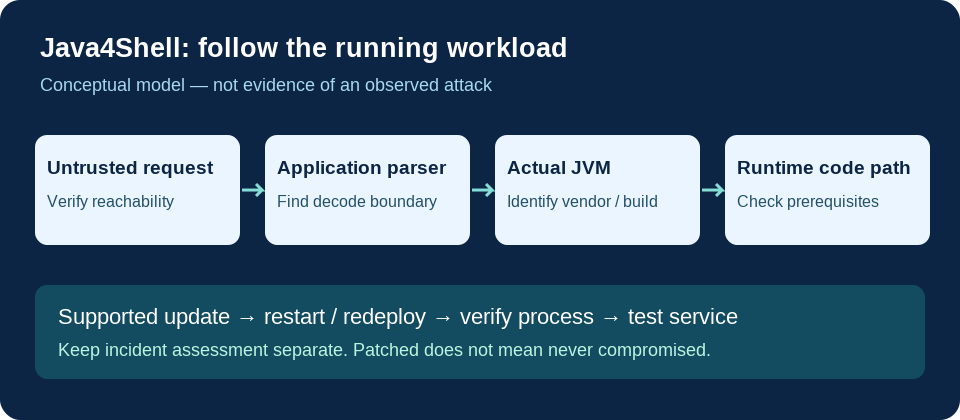
For defenders, draw the boundary from outside request to application parser to runtime to host capabilities. Then mark the controls you can actually verify. An authentication requirement helps only if it precedes the vulnerable processing path. A network restriction helps only if it excludes the relevant caller. Neither statement means that an authentication product or firewall is automatically ineffective; it means the control needs to sit at the right point in the flow.
The diagram below is an original conceptual illustration, not a reconstruction of an observed attack. No malicious input, exploit implementation or bypass procedure is supplied.
Build an inventory that can survive an emergency
Start with the business service, not a spreadsheet of machines. Assign someone who can approve a restart and someone who can interpret the application’s health. Record the service name, environment, owner, exposure, deployment mechanism and evidence location. A vulnerability-management team can coordinate this record; it cannot infer an application’s safe restart procedure from a package report.
For each instance, identify the runtime vendor, complete build string, executable path and how that runtime is delivered. Distinguish an operating-system package from an application-bundled directory, a container image and a managed service. A single host can contain several runtimes. A shell’s default Java executable may have no relationship to the production service.
Ask whether your evidence describes a file on disk, a running process or an image that will be deployed later. Those are different objects. A patched host can continue running an older process. A rebuilt image can sit unused in a registry. An updated production instance can be replaced by an old autoscaling template during the next recovery event. Each state needs its own check.
Capture processor capabilities as exposed to the actual workload, including virtualization and scheduling constraints. Do not extrapolate a result from one node to an entire fleet. Keep mixed architectures and standby environments explicit. When a prerequisite is unknown, mark it unknown and assign an owner; an empty field is not evidence that the service is unaffected.
For vendor appliances or supported commercial products, obtain the vendor’s applicable bulletin and update path. Replacing an embedded runtime independently can break support or application behavior. An unavailable fix should produce an owned temporary restriction and review date, not a silent assumption that an operating-system update solved the problem.
Patch selection: use the correct distribution and prove deployment
Oracle’s JDK 17 release notes identify 17.0.21.1+4 as the full build for its November 17 update. That is a concrete reference for the Oracle release, not a universal package filename or build requirement for every OpenJDK supplier. Read the Oracle release notes [4]. Consult the supplier that actually shipped your runtime and the product vendor that supports your application.
Canonical’s USN-9155-1 lists updated OpenJDK 17 packages by Ubuntu release and says running Java applications need restarting after the system update. Distribution revision suffixes matter when checking a distribution package; compare against the applicable release row rather than discarding the package revision. Check the Ubuntu package notice [5]. This article is not a complete cross-vendor fixed-version matrix, because such a matrix becomes unreliable when suppliers update at different times.
Plan an orderly deployment with a maintenance owner, a health check and a recovery path. Replace the runtime through its supported channel, restart or redeploy the affected workloads, and confirm that the processes now use the intended artifact. For containerized services, track the immutable image digest and observed rollout state. Updating a mutable tag without replacing instances is weak evidence.
Include standby nodes, scheduled jobs, administrative interfaces, authentication components and disaster-recovery templates in the scope discussion. Their operational importance can exceed their daily traffic. A dormant component may become exposed during failover; keeping it invisible in the exception register only postpones the same decision until a more stressful incident.
Record the source advisory and check time alongside the chosen target. If a supplier revises its assessment, that reference makes it possible to distinguish a reasonable earlier decision from a deployment error. Preserve the prior record and add a correction instead of overwriting the history of what the team knew.
Temporary mitigation needs an expiry and a live-process check
Red Hat documents disabling the Base64 intrinsic as an interim option and separately discusses limiting AVX use. Its bulletin warns that the AVX setting is not appropriate for ARM64 JVMs. CERT-EU also documents mitigation options and restart requirements. Use the instructions applicable to your runtime and supported product; do not paste a flag indiscriminately into a fleet-wide startup template. Read Red Hat’s mitigation scope [6].
This briefing deliberately does not provide a universal startup command. Before making a change, confirm that the specific build accepts the option, that the application’s launcher passes it to the correct JVM, and that the service can restart successfully. Ask the vendor about support and test latency, throughput and recovery behavior against an approved baseline.
Define a temporary measure as a bounded decision: affected instance, setting or restriction, approving owner, evidence after restart, operational impact, expiry date and replacement plan. If traffic must be restricted while a fix is unavailable, test the restriction from the intended trust boundary without sending exploit traffic. Preserve required emergency access through an approved process.
After the permanent fix, reassess whether the temporary measure remains necessary. Remove it only through the same controlled process that introduced it, with application health and security checks. An undocumented workaround can become an invisible dependency long after everyone remembers why the emergency was declared.
Safe verification: inspect the process you actually mean
Objective: Establish which JVM version is serving an authorized application after the planned change. Prerequisites: An approved administrative session, the correct process identifier and a supported diagnostic tool in the same relevant operating-system/container context. Oracle documents that jcmd targets a JVM by process identifier and that available commands can be inspected with its help command. Read the jcmd reference [7].
jcmd <approved-java-process-id> VM.versionValidation status: Vendor-documented diagnostic command; not executed against a customer workload for this article. Replace the placeholder with the authorized target’s actual identifier. Do not treat this example as a command to run across unknown or third-party systems. Follow your vendor’s diagnostic and access requirements.
Expected result and interpretation: A version response from the intended running JVM. Compare its output with the supplier’s relevant fixed-build guidance and your deployment record. A successful response does not establish that all nodes were updated, that the application uses no other runtime, or that compromise never occurred.
Failure and false reassurance: Permission failures, a wrong process namespace, unavailable tooling or an exited process can prevent inspection. A different process can return a perfectly valid answer about the wrong service. Resolve the identity of the target before recording success; never convert an inaccessible process into an unaffected finding.
Next steps: Associate the observed process with its service, node, image or package evidence and restart time. Perform a legitimate business transaction, inspect errors and compare operational metrics. Validate each production cohort and failover component. Use vendor-supported tooling for effective mitigation settings where applicable, without assuming that a new shell invocation describes an already running process.
Detection: correlate behavior without inventing a signature
No generic log query can prove exploitation of every runtime memory-corruption flaw. A decoder failure might not create a useful application exception; a successful action might resemble normal service activity. The investigation below is an editorial triage plan, not a tested Java4Shell detection rule or a list of known campaign indicators.
Bring together reverse-proxy or application request metadata, service restart and crash events, endpoint process telemetry, network connections, identity activity and deployment changes. Establish a common time reference and retention window. Note missing sources explicitly. Avoid collecting tokens, credentials or complete sensitive request bodies simply because a vulnerability is under investigation.
Look for a sequence rather than an isolated error: an unusual request pattern followed by an unexpected JVM crash, an unexplained child process, an unfamiliar outbound connection, or changes to service-account activity. Correlate on service, host or workload identity and time. The sequence is a hypothesis generator; it is not sufficient attribution or proof of a particular CVE.
For every lead, compare with deployment jobs, diagnostics, scheduled tasks and known integrations. Application servers may legitimately start helpers. Java workloads may contact new endpoints during an approved release. A process restart may be an autoscaling action. Ask the owner to explain the behavior and preserve the evidence before deciding whether to close or escalate.
MITRE ATT&CK T1190 describes the general initial-access pattern of exploiting a public-facing application. It is a useful organizing reference for the exposed-service investigation; this article does not assign it to a confirmed campaign or infer later techniques without evidence. Review T1190 [8]. Validate any detection in an authorized lab using benign observable events, documented expected results and a rollback plan. No exploit payload is needed to test whether your logging pipeline receives a normal service restart or an approved child-process event.
If evidence suggests compromise, invoke incident response. Preserve volatile or short-retention evidence according to your procedures, identify credential and data exposure, and plan containment with the owner. Patching removes a vulnerable condition; it does not establish the absence of persistence or restore trust in an already compromised service.
A response plan with owners and closure evidence
| Window | Owner and decision | Closure evidence |
|---|---|---|
| Immediate / next 24 hours | Service owner and security team identify affected runtime and reachability; choose supported fix or bounded restriction; preserve logs. | Instance-level inventory, advisory, assigned change and incident leads. |
| Next 7 days | Platform team replaces vulnerable artifacts, validates all cohorts and closes or renews exceptions. | Running-process evidence, deployment digest, restart and legitimate workflow results. |
| 30–90 days | Architecture and operations improve inventory, rebuild automation and recovery templates. | Repeatable evidence collection, accountable suppliers, tested recovery and exception expiry. |
These are suggested planning horizons, not official CVE-specific deadlines or a universal remediation service-level agreement. Highly exposed or suspicious systems can require immediate containment. An internal system with uncertain reachability still needs a documented assessment rather than an indefinite lower priority.
Use a clear state model: unknown, assessed unaffected with evidence, affected awaiting change, temporarily mitigated, fixed awaiting verification, verified fixed, or incident response in progress. Keeping “temporarily mitigated” separate from “verified fixed” prevents a dashboard from turning a risk acceptance into a patch success. Track the denominator of assessed instances; do not publish a reassuring percentage against an incomplete inventory.
For leadership, summarize services at risk, verified coverage, unresolved assumptions, required downtime and owners of exceptions. Avoid a worldwide impacted or patched total without an authoritative measurement. Local asset and evidence counts are useful; guessed global numbers are decoration that can mislead the very decisions the dashboard should support.
Weekly watch: disclosure deadlines are changing, not instantly shrinking to 30 days
Project Zero’s November 13 announcement replaces its earlier model with “Full X”: disclosure after a defined interval from the vendor report. The announced current interval is 90 days, with 60 days planned from February 2, 2027 and 30 days from January 3, 2028. Its standing policy separately addresses actively exploited vulnerabilities and other exceptions. These are Project Zero disclosure rules, not a new law imposing the same patch deadline on every enterprise. Read the dated announcement [9]; check the standing policy [10].
The operational lesson is to measure the path from supplier fix to verified protection. Separate time waiting for a supported update, time preparing your change, time distributing it and time proving that the right instances restarted. Those are different bottlenecks with different owners. A purchasing contract can address supplier notification, while an image pipeline or maintenance process addresses deployment delay.
Ask suppliers how they notify you about bundled components, how an update reaches your installed product and what temporary protections they support. Ask your own team whether an urgent fix can traverse testing, approval, deployment and recovery without improvising the entire process. Shorter disclosure expectations make that preparation more valuable even before the planned future milestones take effect.
Another verified development from the review window is Microsoft’s November 16 report of a high-volume phishing campaign using Microsoft 365 outage lures, observed on November 13. Treat outage-related messages as messages to verify, not privileged recovery instructions. Open service-health information through established channels and investigate suspicious sign-ins through the identity workflow. Read Microsoft’s campaign report [11]. This is a separate social-engineering issue; no evidence reviewed here connects it to Java4Shell.
A fictional change review—and the questions worth asking
Illustrative example, not a reported incident: A service owner has an application with a bundled JVM, two active nodes and a standby image. The host package scanner reports an update, but the application’s configured executable still points to its bundled directory. The team has not yet proved whether the decoder prerequisites apply. The correct initial status is unknown or affected pending assessment, not fixed.
The owner obtains supported product guidance, plans the application update and records the artifact that each node should run. After rollout, operations verifies the target processes and normal application workflows. The standby image is rebuilt before the exception closes. Security reviews relevant telemetry independently. If a process cannot be inspected, that instance remains unresolved rather than borrowing another node’s successful result.
The exercise reveals three uncomfortable questions. Does your inventory describe the runtime currently executing, or only software somewhere on the machine? Can a recovery action reintroduce a vulnerable artifact? Who has authority to accept the temporary exposure when a vendor’s product update is not yet available? Answers require operational ownership, not another severity label.
The bigger lesson is that patching is a chain of evidence. Advisory interpretation, asset identity, supported remediation, deployment, restart, business validation and incident assessment each answer a different question. CyberInsights will revisit this coverage if authoritative sources materially change affected scope, exploitation status or remediation guidance. Until then, the most useful outcome is a smaller set of unresolved assumptions and a defensible record of what is actually protected.
Download the response cheat sheet
Download the one-page Java4Shell response checklist (PDF). The accessible HTML equivalent is the inventory, verification and action-plan guidance above. Use this worksheet on systems you own or are authorized to administer.
Related practical guides
Review software suppliers and deployment evidence · Turn gaps into owned NIST CSF actions · Plan phishing-resistant authentication
By Harpreet Singh, CISSP, CCSP · Original CyberInsights analysis. Editorial policy · Suggest a correction · Home
Plan temporary WAF and firewall protections
For a vendor-neutral control strategy, evidence matrix, safe validation workflow and printable checklist, read Java4Shell beyond patching: WAF, firewall and compensating controls.
Sources and further reading
- [1] Canadian Centre for Cyber Security — AL26-029, November 17, 2026
- [2] Oracle — November 2026 Critical Security Patch Update
- [3] CERT-EU — Security Advisory 2026-021, November 18, 2026
- [4] Oracle — JDK 17.0.21.1 release notes, November 17, 2026
- [5] Canonical — USN-9155-1, November 18, 2026
- [6] Red Hat — RHSB-2026-018, OpenJDK mitigation guidance
- [7] Oracle — Java 17 jcmd command reference
- [8] MITRE ATT&CK — T1190, Exploit Public-Facing Application
- [9] Project Zero — Policy and Disclosure: 2026 Edition, November 13, 2026
- [10] Project Zero — current Vulnerability Disclosure Policy
- [11] Microsoft Security — outage-themed phishing campaign, November 16, 2026