SECURITY ANALYSIS
PQC readiness without false confidence: build a crypto-agility evidence plan
Inventory cryptographic dependencies, prioritize long-lived data and signatures, and test a supported migration path without turning a TLS screenshot into an enterprise readiness claim.
By Harpreet Singh, CISSP, CCSP · Published November 22, 2026
Your public website can have a modern Transport Layer Security (TLS) configuration while the business still depends on older cryptography in firmware, internal services, identity systems and archived records. Post-quantum cryptography (PQC) preparation starts by finding those dependencies and understanding what they protect. A successful connection at the edge is useful evidence, but it is not an enterprise readiness assessment.
The practical task is to build a cryptographic inventory, identify the dependencies that matter most, and test a supported migration path without weakening the service along the way. This guide takes that work from basic terminology through an evidence-backed pilot and a maintained programme.
In this guide
Scope and prerequisites
This is an architecture and programme-planning guide, not an instruction to replace production cryptography immediately. It assumes you can identify service owners, obtain supplier evidence and run an isolated interoperability pilot. Regulated environments, government systems and contractual commitments may have specific requirements that need review by the appropriate authority.
Do not implement a new cryptographic construction or combine algorithms yourself. Use maintained products and supported protocol profiles after reviewing their status. This draft avoids a universal migration deadline and does not predict when a cryptographically relevant quantum computer will exist. Recheck current standards and sector requirements at the time of a deployment decision.
The practical outcome is an evidence-backed work queue: which dependencies are known, which have supported replacements, what the pilot demonstrated and what still blocks acceptance. It is deliberately different from a marketing badge that calls an entire company quantum-safe.
Fundamentals: what changes, and what does not
NIST’s FIPS 203 specifies ML-KEM for key encapsulation; FIPS 204 and FIPS 205 specify ML-DSA and SLH-DSA digital signatures respectively. Key establishment and signing are different functions, so choosing one algorithm does not replace every use of public-key cryptography. [1]
Crypto agility concerns the ability to adapt cryptographic mechanisms while preserving security and operations. It includes protocols, applications, hardware and the processes that govern change, not simply an application setting that accepts several algorithm names. [3]
Separate a cryptographic algorithm from a protocol profile and from a product implementation. Then distinguish a supported product feature from the configuration actually enabled in your environment. Keep implementation assurance and validation requirements separate from the fact that an algorithm has a standard.
| Purpose | Questions to ask | Evidence to retain |
|---|---|---|
| Key establishment | How are session or shared secrets established? | Protocol, negotiated mechanism and library version |
| Signatures and authentication | What verifies identity, software or durable records? | Signature scheme, trust chain and verification path |
| Symmetric protection | What protects stored or transmitted content once keys exist? | Mode, key management and supported configuration |
| Key lifecycle | Where are secrets generated, rotated, recovered and retired? | Owner, hardware or service dependency and tested lifecycle |
Build an inventory that follows the business service
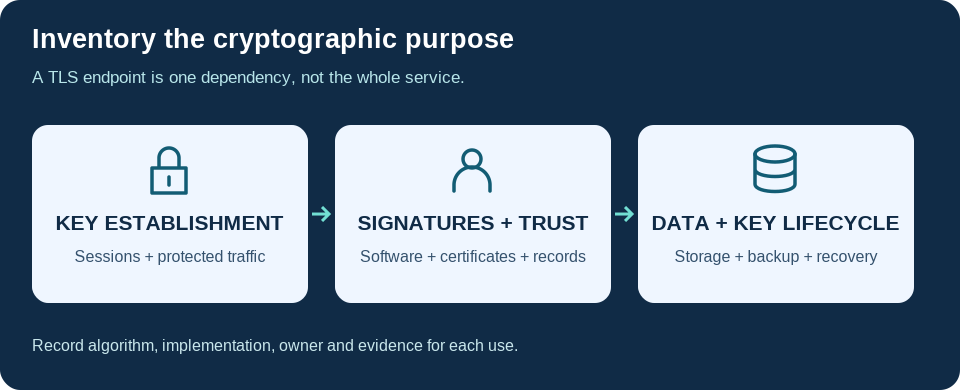
Start with one service and draw its critical transactions. Include the public endpoint, internal calls, identity federation, certificate chain, software supply chain, backups and administrative access. A discovery tool can find some dependencies; reconcile its output with architecture diagrams and owner interviews. Keep “not observed” distinct from “not used.” NIST’s migration project identifies discovery and prioritization as central migration work. [2]
For each use, record the purpose, algorithm or negotiated family, protocol, implementation and version, key or certificate owner, deployment population, data classification and evidence time. Reference a secure inventory location rather than copying private keys or credentials into a spreadsheet. Add the source of the observation and how certain the result is.
A TLS terminator can obscure backend cryptography. A managed platform may expose only an assurance statement. An embedded device may require physical replacement. Record these limitations as separate inventory states, with a person responsible for resolving them. A healthy external scan is not evidence about code signing, internal messaging or long-term archived records.
Prioritize using lifetime and replacement constraints
For confidentiality, ask how long captured information must remain confidential and whether an adversary could plausibly collect its protected form. The harvest-now-decrypt-later concern is a planning reason to examine long-lived information, not proof that a particular record has been captured or that its current cryptography has been broken.
For signatures, ask how long a verifier must trust the record and how trust is renewed. Software packages, firmware and signed business records can have different verification lifetimes from a web session. Consider archival verification and the role of trusted timestamps with specialist input; do not assume reissuing a web certificate fixes durable signatures.
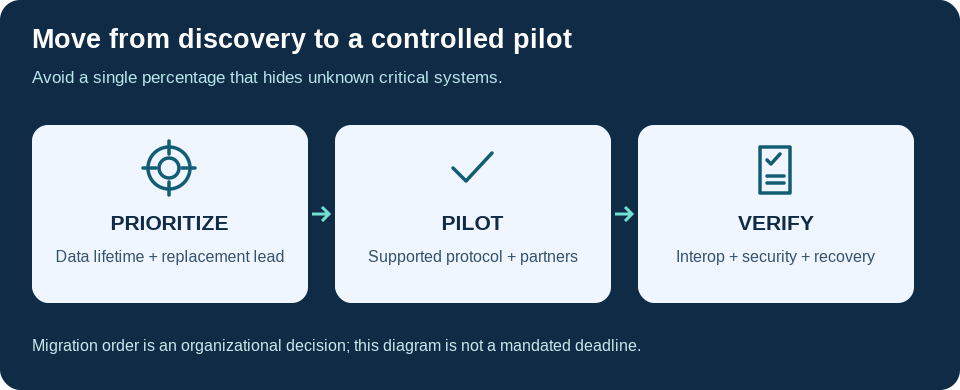
Next examine replacement lead time. Procurement, hardware refresh, supplier certification, partner interoperability and application redevelopment can take longer than a configuration change. A less visible device with a long replacement cycle may need planning before an easily updated public endpoint. Give each decision a documented reason instead of ranking only by internet exposure.
Use a qualitative queue such as investigate now, pilot next and monitor supplier, with an explicit owner and trigger for each item. These categories are editorial planning aids, not NIST assurance levels or mathematically derived probabilities.
Use a readiness matrix that cannot hide critical unknowns
A single readiness percentage encourages teams to count easy endpoints and overlook hard dependencies. Instead, show independent dimensions and the evidence behind them. Use unknown, documented, demonstrated and operationally accepted as local workflow states. They are not a recognized certification scheme. A service can be documented in one dimension and unknown in another.
| Dimension | Documented | Demonstrated | Blocking gap |
|---|---|---|---|
| Coverage | Expected service dependencies named | Observations reconciled against owners and deployment population | Critical dependency missing or unowned |
| Replacement support | Exact supplier and version support identified | Supported profile exercised in pilot | Only a roadmap or unsupported extension |
| Interoperability | Client and partner matrix defined | Representative paths complete successfully | Critical partner or constrained client untested |
| Security behaviour | Expected negotiation and failure rules approved | No unacceptable fallback under approved tests | Silent downgrade or ambiguous authentication |
| Operations | Rollback, monitoring and lifecycle documented | Recovery and rotation exercises completed | Cannot restore service without weakening protection |
What a TLS observation can and cannot tell you
TLS version, key establishment and certificate authentication are separate observations. TLS 1.3 does not by itself establish post-quantum protection. A certificate’s signing algorithm does not identify the negotiated key-establishment mechanism. An edge observation also says nothing conclusive about the connection from that edge to a backend service.
If a supported hybrid mechanism is under evaluation, document its exact profile and implementation. Its security properties depend on the specified construction and correct implementation; do not claim that every arbitrary pairing remains secure whenever either component survives. Check current interoperability and deployment guidance for the product being used.
TLS guidance itself evolves. The NIST SP 800-52 Rev. 2 page currently carries a revision planning note; treat its published context and any replacement guidance carefully rather than repeating an old minimum as a universal recommendation. [4]
For a pilot, preserve the client and server versions, observed negotiation result, certificate path, trust validation and whether connection resumption changed the observation. Sanitize traces: packet captures and verbose diagnostics can contain session metadata or secrets. Obtain authorized collection and storage rules before enabling them.
Design a representative migration pilot
Choose a service with a clear owner, recoverable state and enough representative clients to teach you something. Build a matrix including browser or SDK families, mobile versions, proxies, load balancers, service meshes and monitoring agents where those are part of the real transaction. A single new command-line client is not a representative estate.
Keep the baseline configuration and acceptance criteria under version control. Compare the same approved synthetic operation before and after the change. Do not disable certificate validation or relax authentication to make interoperability appear successful. Define who can halt the pilot and what observations require a rollback.
Test functional success, certificate and identity validation, negotiation policy, resource use and operational recovery. Measure handshake or verification latency, error rate, message size and resource pressure under a safe representative load. Interpret them as local measurements with stated hardware, software and sample conditions, not general benchmarks for an algorithm.
Failure testing belongs in the isolated environment. Establish what happens when a peer lacks support, a dependency is unavailable, a certificate expires or a configured policy cannot be met. Some systems must fail closed; others may have a specifically approved transition policy. The business and security owners must agree the intended result before the test.
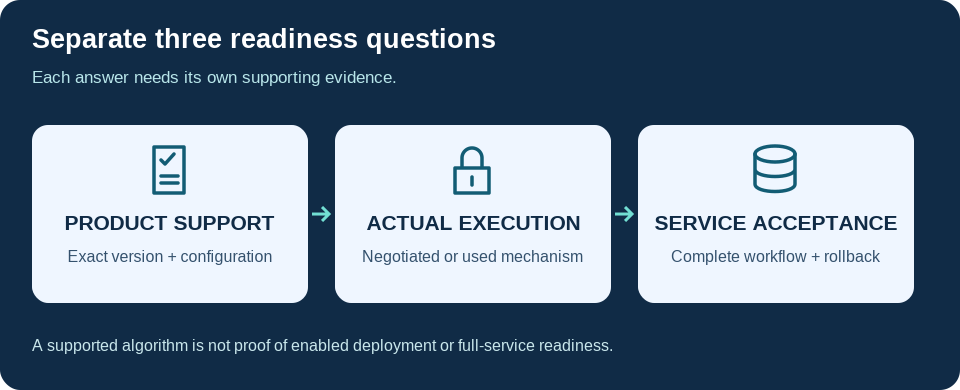
Collect three separate acceptance records
Product support. Preserve vendor documentation for the exact version and profile, including support boundaries and required modules. A press release or future roadmap is not evidence that today’s deployment can use the feature. If module validation matters, obtain the relevant validation and approved-mode information rather than assuming it follows the algorithm.
Actual execution. Record the mechanism negotiated or used by the serving process. Include deployment coverage, routing and any fallback conditions. A configuration file on disk does not establish the behaviour of an older process that has not restarted.
Service acceptance. Retain the complete synthetic transaction result, authentication outcome, performance observations and recovery test. Record unchecked clients and dependencies. Obtain application, security and operations review for their respective responsibilities instead of asking one person to attest to everything.
Hypothetical cases: different dependencies, different priorities
Case A — long-lived research records. A service handles confidential research expected to retain value for years. The team prioritizes its protection paths and key-establishment dependencies, while investigating archival copies and partner exchanges. It does not infer that changing only the browser connection protects every historical copy.
Case B — signed firmware on a long-life device. The most important dependency is the device’s update verifier and trust anchor. A server TLS upgrade may help transport but cannot replace an immutable verification implementation. The product owner evaluates vendor support, replacement options and lifecycle constraints.
Case C — a short-lived public information portal. Its content is public, but administrator authentication, software signing and customer identity integrations still matter. The team may select it as a low-impact interoperability pilot while acknowledging that its results do not validate a payment service or a constrained industrial device. These are fictional planning examples, not measured deployments.
Common failure modes and supplier questions
- Counting certificates instead of services: a certificate inventory is useful but does not cover all cryptographic purposes.
- Confusing code presence with runtime use: a library may support an algorithm that the deployed profile never selects.
- Forgetting verification: signatures need compatible verifiers throughout their useful life, including offline and recovery environments.
- Unsupported experimentation: a proof of concept may use a protocol extension that is unsuitable for production support.
- Rollback without a security decision: restoration must not silently move the service to an unacceptable policy.
Ask suppliers which exact releases and deployment modes are supported, which dependencies remain classical, how interoperability is tested, what implementation assurance is available and how migration affects keys, certificates, backups and disaster recovery. Request evidence and review dates rather than a yes-or-no “quantum-ready” answer.
Turn the pilot into a maintained programme
Assign an architecture owner and connect the inventory to procurement, service onboarding and change review. New software can reintroduce an old dependency; an inventory that is only refreshed annually may miss it. Trigger rechecks on library upgrades, certificate architecture changes, platform migrations and supplier support announcements.
For a first planning cycle, select one service, complete its dependency map and resolve the largest unknowns. Use the findings to estimate work and dependencies before promising enterprise completion. Include training for the teams that own PKI, application runtime, networking and recovery, since cryptographic changes cross those boundaries.
Publish an internal status that separates coverage, support, demonstrated interoperability and accepted operations. Keep source dates and uncertainties visible. The useful deliverable is a sequence of defensible changes with accountable owners, not an assertion that a checklist predicts the future or guarantees quantum resistance.
Your reusable review checklist
Use this checklist to structure your review. Completion is not an automated security assessment. These checkboxes are temporary and are not uploaded or saved.
Download the one-page PDF cheat sheet · Download the blank evidence worksheet (CSV)
Check your understanding
Does TLS 1.3 by itself prove post-quantum protection?
No. Protocol version alone does not identify a post-quantum mechanism. Establish the negotiated group, authentication scheme and the implementation’s supported profile.
Does a standardized algorithm mean our HSM or application is validated?
No. Standards, product implementation, validation status and enabled deployment are separate facts. Check each one in the exact environment.
Can we average unknown critical dependencies into a readiness score?
That can conceal the most consequential gap. Report unknown coverage explicitly and keep critical blockers visible regardless of averages.
About this guide
Definitions and attributed framework statements are supported by the primary references below. The workflows, tables and hypothetical examples are original editorial synthesis. No customer environment or product configuration was tested for this article; the examples do not establish compliance or certification. Sources reviewed November 22, 2026.