SECURITY ANALYSIS
MONAI Label CVE-2026-133968: secure the service and investigate the exposure
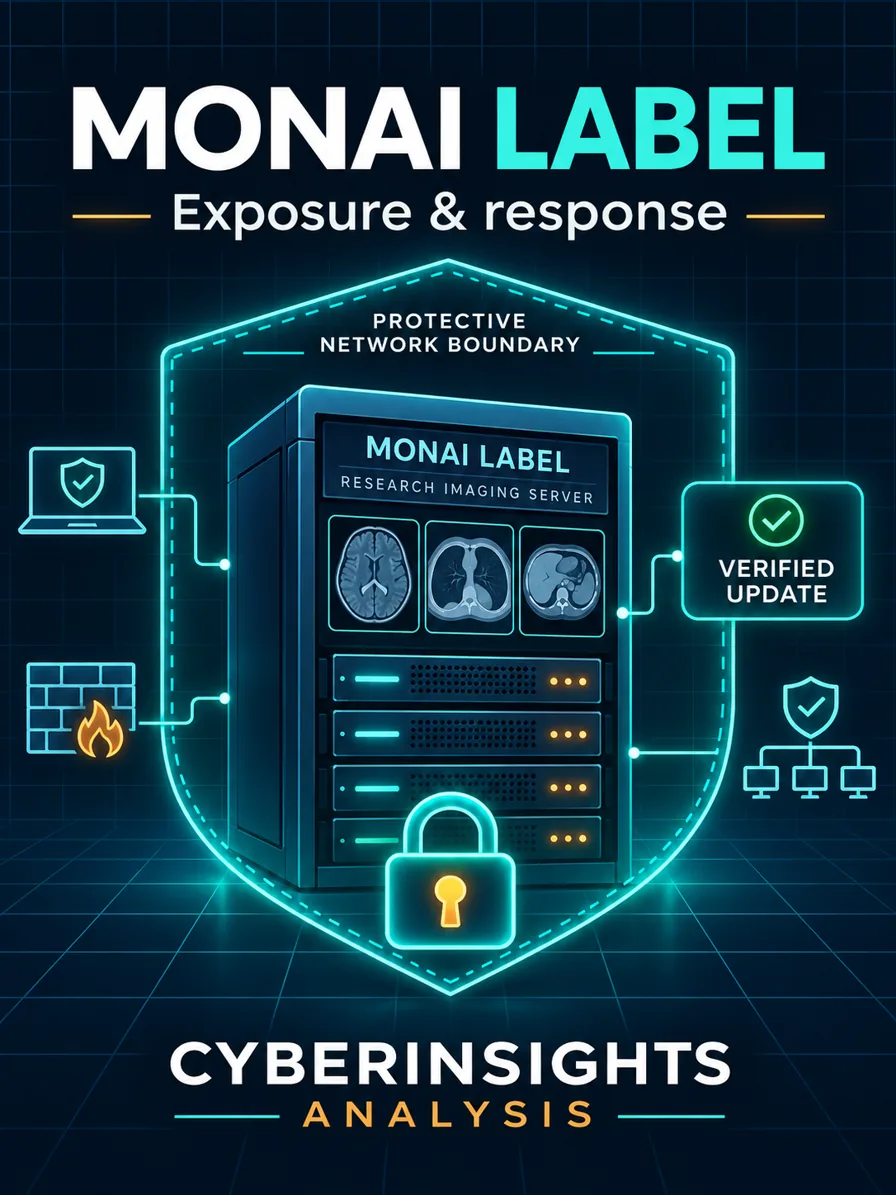
MONAI Label CVE-2026-133968 response: identify affected deployments, restrict exposure, verify the supported security update and investigate suspicious changes.
By Harpreet Singh, CISSP, CCSP · Reviewed November 24, 2026
A research application can become an enterprise exposure when its network access, filesystem permissions and patch ownership are left implicit. MONAI Label CVE-2026-133968 makes those boundaries urgent: identify affected deployments, limit unnecessary access, use the supported security release and investigate unexplained changes before declaring the service trusted.
The issue now appears in CISA's exploited-vulnerability catalog. This analysis separates what the maintainers and researchers establish from the operational checks an administrator still needs to perform. It is for platform teams, research IT and incident responders; it provides no exploit reproduction.
In this report
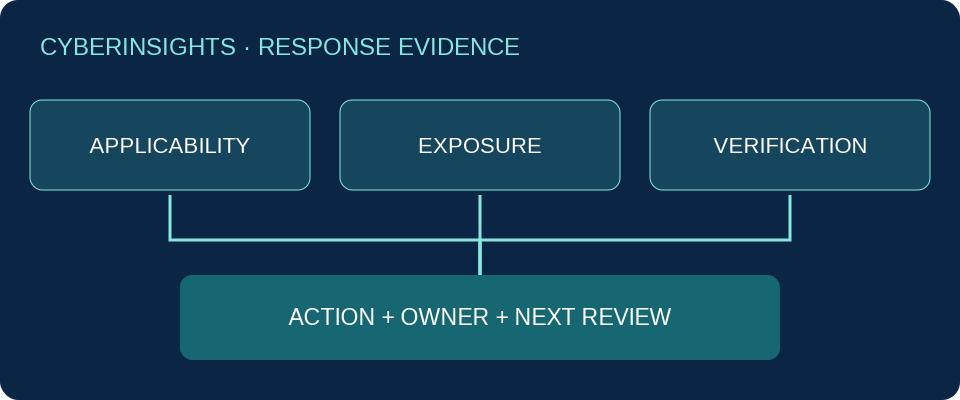
What the published evidence establishes
The MONAI Label maintainer advisory identifies a path traversal problem affecting versions through 0.8.5, with 0.8.6 listed as patched. The November 22 release also addresses a separate session-upload path problem. Update planning should follow the release guidance rather than treating one endpoint restriction as a complete fix. [1] [2]
CISA added CVE-2026-133968 to KEV on November 23. Its snapshot lists November 26 as the due date and indicates forensic triage, while ransomware campaign use is unknown. That date belongs to the catalog's federal remediation context; organizations outside that scope should set their own accountable response deadline instead of presenting it as a universal legal requirement. [3]
Amazon Threat Intelligence reported on November 20 that AI agents found and exploited an initially unknown medical-imaging application flaw during a September campaign. Its attribution is an assessment, not independent proof supplied by this publication. The report includes failed operations as well as a successful compromise; it does not show that every AI-assisted attempt succeeds. [4]
The important boundary is the server process
Path traversal means untrusted input can influence a filesystem destination beyond the intended directory. For a defender, the important consequence is the gap between where an upload should be stored and where the operating-system process is allowed to write. Broad process permissions can make that gap more consequential.
Use a service-boundary review rather than replaying an exploit. Identify the service account, writable directories, mounted storage, credentials available to the process and network dependencies. This is an assessment of your own deployment; the fact that software is used for medical-imaging research does not establish that a particular installation handles patient information.
A reverse proxy or WAF should not be assumed to repair unsafe filesystem behavior. A control may reduce access to a particular request path but still leave direct origin access or other upload features reachable. Establish which clients can reach the service before deciding what a temporary restriction covers.
Start with a complete deployment inventory
Include lab servers, GPU hosts, container stacks, demonstration instances, temporary research machines and services reached through a VPN. Ask research and platform owners about deployments outside the standard application inventory. Record the actual runtime, installed package or container image, service identity and responsible operator.
A read-only local package check can help when it is executed inside the Python environment used by the running service:
python -m pip show monailabelThis is a documentation-based administrative check, not a vulnerability detector, and was not executed on a MONAI deployment for this report. It requires permission to inspect the relevant environment. The expected result is package metadata including its version; no package found may mean the wrong environment was inspected. A host's default Python environment is not necessarily the container or virtual environment serving requests.
For containers, compare the running image identity and deployment specification through your existing orchestration tools. Record immutable image identifiers where available, not merely a mutable tag. Include dormant templates that could recreate an older instance later.
Contain access without losing the evidence
Restrict unnecessary client paths using the controls operated by the network or platform team. Document what changed, who approved it and how legitimate annotation work will continue. A hurried global block can interrupt research workflows; a narrow rule that misses the origin can create false confidence.
The maintainer's interim guidance is to keep the service off untrusted networks, enable authentication, restrict trusted roles and run with limited operating-system privileges. These measures reduce exposure but do not replace the supported update. Preserve evidence when changing accounts, permissions or service placement. [1]
Agree an evidence collection plan with the incident lead before rebuilding a potentially affected host. Preserve appropriate application, reverse-proxy, identity, operating-system and network records. Handle sensitive research or personal information through approved access controls and retention rules. Do not copy datasets, secrets or session material into an ordinary ticket.
Update, then verify the service that actually runs
The 0.8.6 release is the supported security update identified in the reviewed release notes. Verify the appropriate distribution and your dependency compatibility with the maintainer guidance. Do not hot-edit a production source file based on an internet snippet and call that an equivalent tested release. [2]
Before deployment, agree representative acceptance tests with the service owner: sign-in, authorized image access, annotation save and required integrations using synthetic or approved non-sensitive data. Confirm that allowed storage operations still work and that an untrusted client cannot reach the service through an unintended route. These are acceptance objectives, not claims that a specific workflow has been tested here.
After restart or redeployment, repeat the runtime inventory and retain the resulting evidence. Check each relevant instance. If the update breaks an essential workflow, follow the approved rollback plan while maintaining containment and reopening the remediation decision. An operational rollback must not disappear from the security record.
Hunt for changed behavior, not an invented signature
| Question | Evidence to correlate | Limit |
|---|---|---|
| Who reached the service? | Ingress logs, proxy records, identity context and approved client inventory | A proxy may hide the original source unless trusted forwarding is configured |
| Were files changed unexpectedly? | Known-good deployment comparison, integrity records and change approvals | Timestamps alone do not establish who changed a file |
| Did the service start unusual child processes? | Process telemetry and administrative activity | Training and maintenance can legitimately create processes |
| Did it contact unexplained destinations? | Egress records, service dependencies and maintenance windows | External connectivity alone is not evidence of exploitation |
This is a behavior-led editorial hunt plan, not a validated CVE-specific rule. Correlate observations across sources and preserve both the event and the analyst's interpretation. Missing logs lower confidence; they do not clear a host. Avoid publishing untested error strings or claiming that a single indicator reliably detects every exploitation attempt.
Choose an investigation window from the deployment's exposure history and available retention, not only the date the advisory was published. Resolve suspicious findings through the incident process. If host trust is lost, agree the rebuild, identity and dependency recovery scope with the responsible teams before returning it to service.
What this case changes for AI infrastructure owners
The immediate response is ordinary security engineering applied to a sometimes overlooked application: know the runtime, constrain access, limit privileges, patch through a supported path and investigate unexplained changes. The AI-assisted attacker narrative should not distract from those controls. A research service deserves an owner even when it was deployed for a short experiment.
Hypothetical consequence: a lab moves a temporary annotation container onto a broadly reachable GPU host, mounts a shared research directory and never records who owns patching. An upload weakness could then affect more than the annotation workflow. This is a teaching scenario, not a reported victim. The preventive change is a deployment gate covering network exposure, service privileges, storage mounts and an update owner.
Ask whether temporary research deployments inherit baseline access controls and whether their termination actually removes reachable services and credentials. Keep governance of your own agents separate from vulnerability response: the agentic AI control plan addresses action authority, while this report addresses a server vulnerability.
The evidence required before closing the response
- All relevant MONAI Label deployments have owners and recorded runtime evidence.
- Supported remediation and operational acceptance results are retained per instance.
- Untrusted access paths and service privileges have been reviewed.
- Unexpected file, process, account or network activity is resolved or escalated.
- Investigation windows, telemetry gaps and residual uncertainty are explicit.
- Exceptions, dormant templates and rollback states have a next review.
Download the one-page response checklist · Download the blank response register
Continue with evidence-led vulnerability prioritization, production patch verification and the matching Threat Intelligence advisory. Keep the service's patch state, exposure review and compromise assessment separate in the closure record.
Reviewed November 24, 2026. Sources may be revised. No MONAI server, detection query, exploit or customer environment was tested for this report. The code example is a read-only inventory aid; no offensive reproduction or payload is provided.