SECURITY ANALYSIS
VMware vCenter CVE-2026-123890: contain access, verify the patch and investigate trust
A defensive vCenter response guide: confirm affected versions, limit management access, verify patches, investigate privileged activity and document recovery evidence.
By Harpreet Singh, CISSP, CCSP · Reviewed November 22, 2026
A management-plane vulnerability changes the question from “Which server needs a patch?” to “Can we still trust the systems that manage the estate?” CVE-2026-123890 deserves that wider response. Establish the affected deployments, restrict unnecessary access, apply the supported update and investigate whether privileged activity preceded the change.
This report is for virtualization administrators, security operations and incident leads. It explains the confirmed advisory, then develops a practical evidence-led response. Software remediation, access containment and compromise recovery each need their own acceptance decision.
In this report
What is confirmed, and why this matters
Broadcom rates CVE-2026-123890 Critical at CVSS 3.1 9.8 and describes an authentication bypass in the VMware Directory Service. Its advisory lists patches and no workaround. [1]
Mandiant and Google Threat Intelligence Group report exploitation since early September 2026. Their research identifies an SRP session-key disclosure through the directory service’s DCE/RPC interface, with TCP 2012 relevant to the observed activity. This is not evidence for the draft’s proposed malformed-SASL fallback mechanism. Keep those explanations separate. [2]
CISA’s published catalog records addition on November 20, 2026, a November 23 due date and a forensic-triage requirement. Its ransomware-use field is “Unknown.” The catalog deadline must be interpreted within the applicable directive and organizational obligations; it is not a claim that every organization has the same legal deadline. [3]
A virtualization management service is a concentration of trust. Treat the response as a business-service issue: identify who can authorize an outage, which administrators can operate during containment, and which recovery dependencies might be affected. A vulnerability finding belongs in an owned incident or emergency-change record, rather than an unassigned spreadsheet.
Find the exact deployment before choosing an update
Record the appliance identity, version, build, deployment family, owner and maintenance path for every instance. Include recovery environments and disconnected management networks. An inventory that only lists the primary data centre can miss the system that becomes active during a failure.
| Deployment branch | Vendor response reviewed November 22 | Decision to document |
|---|---|---|
| vCenter 9.1.x.x | 9.1.1.0200 | Confirm branch and supported upgrade path |
| vCenter 9.0.x.x | 9.0.2.0200 | Validate compatibility and prerequisites |
| vCenter 8.0 | 8.0 Update 3m | Confirm the installed build after updating |
| vCenter 7.0 | Contact Broadcom Support for extended-support guidance | Do not invent a public fixed build |
| VCF 5.x and Telco deployments | Use the product-specific advisory instructions | Respect the managed component lifecycle |
These are the response-matrix entries checked for this report, not a permanent compatibility promise. Reopen the advisory before each change. A newer version must still belong to a supported upgrade path. Do not read an SDDC Manager fixed version as a vCenter build. [1]
For a provider-managed deployment, ask for written applicability and remediation evidence. Establish who patches the component, what status is visible to you and what customer-side investigation remains your responsibility. Do not extrapolate an on-premises conclusion to every hosted VMware service.
Map reachability beyond the web login
A Web Application Firewall (WAF) evaluates traffic that actually passes through its configured inspection path. It cannot establish coverage for a separate management protocol or an internal route around that path. Review the management network as a collection of permitted source, destination and service combinations, rather than a single protected hostname.
Create a dependency map covering administrative workstations, backup servers, monitoring, identity services and other management nodes. For each permitted connection, record the reason, owner and expected service. Compare the intended policy with firewall rules and observed flow logs. A rule labelled “management” is insufficient evidence if it allows an entire network to every appliance port.
As a proposed compensating-control strategy, narrow unnecessary reachability through supported upstream controls, preserve required operations and verify both allowed and denied paths. Test from an authorized representative source; record the time, destination, policy decision and expected result. A successful connection does not prove exploitability, and a timeout does not prove a correctly enforced deny rule.
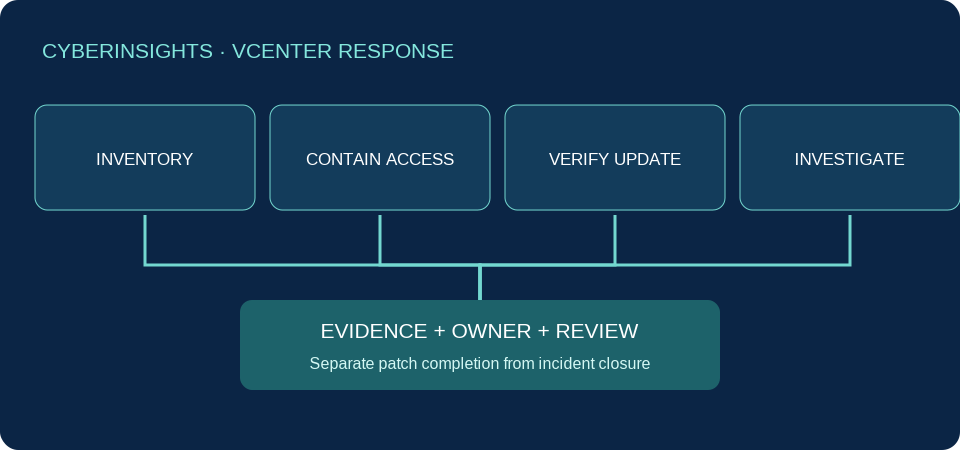
Use explicit change control for network policy. Prepare out-of-band access and a rollback decision before modifying critical access. Validate backup, monitoring and administrative workflows afterward. Avoid copying unreviewed appliance firewall commands into production; a command that reloads configuration is a modifying action, not a read-only inspection.
Patch as an emergency change, with a recovery plan
Broadcom’s FAQ directs customers to fixed releases and distinguishes this issue from earlier vCenter vulnerabilities. It also identifies a specific asynchronous patching route for VCF 5.x. [4]
- Prepare: confirm product compatibility, prerequisites, free capacity, authorized credentials and a supported backup/recovery method. Verify access to the recovery record before the outage.
- Assign: name a change lead, incident lead and business decision-maker. Agree on stop conditions and who can approve rollback.
- Execute: follow the instructions for the actual deployment branch. Retain the job record and timestamps. Do not substitute a generic ISO or old procedure for current product guidance.
- Verify: check the running version and build through the supported interface, appliance health and completion of the update workflow. Confirm required restart or service actions from the release instructions.
- Exercise: test a representative administrative action, monitoring collection and a safe backup or recovery-management workflow. A login page loading is only one observation.
For multi-node, linked or recovery arrangements, record each instance separately. “Primary complete” must not silently become “estate complete.” Keep unsupported, unavailable and unverified instances visible, with owners and deadlines. Recheck temporary network exceptions when the change closes.
Investigate using evidence, not invented log signatures
Open an investigation window that reflects possible earlier exposure and retained telemetry. Collect appliance, identity, management-task and upstream network records under your incident process. Preserve timestamps, collection scope, hashes and access controls. Record where logging was disabled, retention expired or forwarding failed. Missing telemetry is an uncertainty, not a clean result.
The following hunt plan is editorial guidance, not a validated CVE-specific detection rule. Translate it into the schemas and event names actually collected in your environment. Start with behavior and correlation rather than assuming a distinctive error message exists.
| Question | Evidence to correlate | Alternative explanation to check |
|---|---|---|
| Who reached sensitive management services? | Source ownership, firewall decisions, flow times and authorized maintenance | Monitoring or backup activity may be legitimate |
| Did privileged access change unexpectedly? | Account creation, role changes, administrator sessions and approved changes | Emergency administration still needs attribution |
| Were appliance access settings altered? | Management events, shell access changes and remote audit records | Support activity must match a ticket and operator |
| Did activity spread to related systems? | Identity, backup and host-management timelines | Routine jobs can create bursts of traffic |
Ask an analyst to reconstruct a timeline across independent sources. An unexpected account followed by management activity from an unexplained source is more useful than a lone string match. Preserve the original event and the reasoning behind escalation. Avoid exporting secrets, session tokens or directory databases into ordinary tickets.
No exact error string or packet signature in this report is presented as a validated CVE-specific detection. An absence of matching alerts cannot clear an appliance. The published research contains useful incident context alongside offensive implementation detail; defenders should use it for source verification and approved investigation, not reproduce an exploit chain.
Keep containment and trust recovery separate
Install the supported patch to address the vulnerability, but retain a separate decision about whether the management environment can be trusted. If there is evidence of unauthorized privileged activity, involve the incident-response lead and vendor support. Define the affected identity boundary, connected services and evidence-preservation requirements before performing broad recovery actions.
Do not make certificate replacement, password rotation or appliance rebuilding a reflexive first command. Those changes can interrupt authentication, invalidate evidence or create an incomplete recovery if dependencies are missed. Plan an ordered recovery with the responsible teams: what must be isolated, which trust material may be affected, where credentials are used, which sessions need action and how dependent services will be validated.
A defensible recovery record states what was rebuilt or changed, why that scope was chosen, what remained out of scope and who accepted the residual uncertainty. Require verification from a known trusted administrative path. A patched appliance with unexplained privileged access is not ready for an unconditional incident closure.
Two examples of how an apparently successful response can fail
Hypothetical example: the protected login. A team places the web interface behind a WAF and closes its patch ticket. A backup network still has broad management access. The control protects the intended web path but does not establish protection for other services. The correction is a service-level reachability review, supported updates and investigation of unexplained access—not a stronger claim about the WAF.
Hypothetical example: the forgotten recovery site. The production appliance is updated and tested. A recovery instance remains on an older branch because it rarely runs. During an outage it becomes an active dependency. The correction is a per-instance evidence register, including dormant and failover systems, with separate acceptance results.
Neither example describes a customer incident or a tested exploit. They illustrate why asset scope, operational dependencies and evidence quality should be agreed before declaring remediation complete.
A closure checklist your team can reuse
- Every management instance has an owner, product branch and verified build.
- The current vendor advisory and applicable deployment instructions are attached to the change.
- Required network paths are documented; unnecessary access is restricted and checked.
- The update completed and representative operational workflows passed.
- Investigation scope, retained logs and visibility gaps are recorded.
- Unexpected accounts, privileges and management changes are resolved or escalated.
- Recovery decisions address trust dependencies, rather than only software version.
- Residual risks, temporary exceptions and the next review have named owners.
Download the one-page response checklist (PDF) · Download the blank evidence register (CSV)
For governance reporting, keep three states separate: vulnerable software remediated, network exposure reviewed and compromise investigation completed. These are editorial evidence categories, not an automated certification or a framework-equivalence claim. Link the record to your NIST CSF 2.0 improvement work and your organization’s incident and change processes.
Continue with production patch verification, session-revocation verification, or the Threat Intelligence advisory dashboard.
Research reviewed November 22, 2026. Product guidance can change. This report gives defensive planning and verification advice; no customer environment, detection query or recovery workflow was executed as part of writing it.